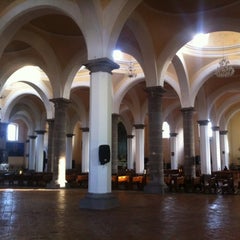
For any number of reasons Oaxaca has been on our list of places to visit in Mexico. People tell us it is their favorite city in Mexico. We hear of the many types of folk art that can be found in the area. But the situation for an RV of our size has been questionable for years. We have tried to look into it and tried to gather information but we have just not been able to figure a way to make the trip to Oaxaca in our Bus.
That has changed. Del & Kate have opened a small RV park / campground about 10 miles SE of Oaxaca City which not only gives us access to the city but to many surrounding villages. As soon as we heard this was happening we made plans to head in that direction. Christmas seemed a good time to be here.
The campground has about 9 spaces with hookups and plenty of open space for other campers. Typical of Mexico the electricity is limited as is the water pressure. But we are more or less self-contained and we are used to this conditions in Mexico. We keep our water tank full and use our 12 volt pump to pump from our fresh water tank.
Del and Kate have been in the Oaxaca area for eleven years and have a wealth of information about the area that they are happy to share. They live on the grounds and do a nice job of keeping an eye on things, including walking Tilly when we're out and about for a long day.
We planned our stops along the way so we would not have a lot of miles to travel to get to Oaxaca driving on unfamiliar roads. Our route took us out of Cholula near Puebla on MX 150D toward Orizaba. We turned off MX 150D on MX 135D toward Oaxaca. Both of these roads are toll roads and not in the smoothest conditions. But that is one of the problems about getting to Oaxaca – there aren’t a lot of options as to how to get there. Once close to the Oaxaca area 135D ended and we got on MX190 close to the city and on more or less city streets – lots of traffic lights and traffic and a bit of confusion. After a few miles of stop and go we were back on open roads heading SE of Oaxaca toward our destination in San Francisco Lachigolo (sort of rhymes with gigolo).The Oaxaca Campground is not far off MX190 on a rough dirt road – turn by the pink paint store.
Monday, December 28, 2015
Thursday, December 24, 2015
Oaxaca Rugs (Tapetes) from Teotitlan
As we drove on the road toward centro, we passed many rug places. Some of them were large and some were small, but they all had gorgeous rugs on display. We decided to concentrate on the central area of town. Families in Teotitlan have been producing rugs for many years, and the skill is passed from one generation to another. Our first stop was at a shop called Huizache belonging to the Alexander Mendoza family.
We were greeted by Veronica, one of the family members.
Many of the shops and workshops are in the family home, as this one was. Veronica took time to show us around and demonstrated some of the process of rug making. She explained the difference between the types of dyes used, whether natural or artificial. The type of dye as well as the intricacy of the rug pattern determines the price of various rugs. Her conversation with us helped us to understand what's important to look for when buying a quality rug.
The most valuable red dye is called cochineal. Cochineal dye was used by the Zapotecs. Produced almost exclusively in Oaxaca by indigenous producers, cochineal became Mexico's second-most valued export after silver. At one time is was more valuable than gold. It has such an interesting history that an entire book was written about it called A Perfect Red, written by Amy Butler, It's a good read.
Cochineal dye comes from the cochineal insect. They're found on the paddles of prickly pear cacti, then are brushed off and dried. Veronica showed us how the cochineal is ground and goes from gray to red. It's then mixed with water, and heated while the woolen skeins are added.
She also told us about the other dyes used for the wool - many are derived from plants. There were skeins of the various colors of wool hanging, waiting to be woven.
After thanking Veronica for her hospitality we went into the central marketplace where many stalls can be found. There are so many stalls that it gets a bit overwhelming and difficult to distinguish one from another. The photo below is just the tip of the iceberg.
We were pleased to get a bit more education at one of the stalls. The women were fun and we enjoyed their demonstration. We found out more about cochineal dye - crazy but if lemon is added to the dye mixture it changes the color.
The wool is first carded - the paddles remind us of the brushes used to groom dogs.
The wool is then spun on a spinning wheel - the whole process is amazing to me.
Once the wool is spun into what I guess you would call yarn, it's dyed and then woven into a rug. The woman doing this had to have very strong legs and arms to work the loom.
So very interesting and what a skill. Now that we have an idea of what to look for, we hope to go back and purchase one of these very special rugs.
In addition, there is a museum and research facility that is supposed to be the premier place to learn about cochineal in Santa Maria Coyotepec called Tlapanochestli (try to pronounce that). Hopefully we'll get there and learn more about cochineal.
Monday, December 21, 2015
Talavera Pottery and Puebla
![]() |
| Entryway to Uruiarte Talavera in Puebla |
Authentic Talavera pottery only comes from the city of Puebla and the nearby communities of Atlixco, Cholula, and Tecali because of the quality of the natural clay found there and the tradition of production which goes back to the 16th century. This is one of the reasons we wanted to stop in Puebla and learn more about Talavera pottery. We have been to other areas where the pottery is called Talavera, but if it's not from Puebla it's not real Talavera. We chose to visit Uriarte Talavera, a traditional Talavera enterprise in Puebla that has been in existence since 1824. It was begun as a family workshop by Dimas Uriarte, but today it is run by a business group.
Brian's research led us to believe that Uriarte was the best place to get a tour and it was probably right. We were the only ones on the tour which was very informative to say the least.
The following photo shows the basic process. First, black and white clay are mixed and shaped. The piece is then fired, and when it cools a glaze is applied. The glaze dries and a stencil is applied so that the piece may be painted. After painting, the piece is fired again and is finished.
Originally Talavera was mainly cobalt blue and white. Now there are 6 colors used - yellow, green, black, orange, sky blue and cobalt blue. All of the colors are obtained locally except for cobalt blue which comes from Africa.
The colors are ground with a large rock being pushed by a turning wheel and paddle - the blue cobalt is shown below, ready to be ground.
A series of pulleys and belts connect a machine to the grinder.
After the clay is mixed the potter shapes the pieces. We were told that Uriarte has 5 potters. Really interesting to watch how quickly the potter worked and how adept he was with the wheel.
After the first firing a glaze is applied to the pieces. The wet pieces are yellow and turn white when they're dry and ready for the stencils.
After the pieces are dry, it is the job of one man to level the bottoms and hand paint the Uriarte logo with a donkey hair brush. He must have a very steady hand!Charcoal is used to apply the stencils to the pieces. It was explained to us that the stencil tells the painters which colors to paint and where to paint them.
The painters were working on a variety of pieces. The ball this woman is painting appears to be something for the holidays.
These pieces are painted and ready for firing in the oven.
The original oven still stands in one of the courtyards.
The new oven is obviously larger.
It appears that these two large religious figures are on platforms that roll into the oven, ready for the first firing. They will then be glazed, the glaze allowed to dry, stenciled, painted and fired again.
It was a truly fascinating tour and it would take a book to tell all about the process and history of Talavera. Our guide was extremely informative and friendly, and we were able to take our time and ask lots of questions. We highly recommend touring Uriarte if you're in the area.
As a comparison, I took a photo showing Talavera from Puebla, the real thing, and pottery from Dolores Hidalgo in the state of Guanajuato which the people there call talavera. Talavera manufacturers like Uriarte have been under pressure from imitations, commonly from China and similar ceramics from other parts of Mexico, especially Guanajuato. Guanajuato state petitioned the federal government for the right to share the Talavera demonimation with Puebla, but, since 1997, this has been denied and glazed ceramics from other parts of Mexico are called Maiolica or Mayolica.
![]() |
| Dolores Hidalgo on the left, real Talavera from Uriarte on the right, pretty easy to tell the difference. Also reflected in the cost, of course. |
Puebla
While we really enjoyed touring Uriarte, I found the city of Puebla to be overwhelming. Too much traffic, big crowds, and the pollution had my eyes watering pretty much the whole time we were there. We walked to the Zocalo, or main plaza, and had a pretty mediocre lunch. After that we walked around the square. There was a lot of activity going on for the holidays including this angel on stilts who was happy to pose
a snow hill for tubing
and an ice skating rink where it looked like there was a problem keeping the ice cold enough to skate on.
The main church on the plaza, as well as many of the other buildings in Puebla, shows the effects of pollution in the city. Tough to keep them cleaned, I'm sure.
Many of the building facades in the city are tiled and some of them are very nice.
Cholula and The Pyramid of Quetzalcoatl
The city of Cholula is located just west of the state capital of Puebla and is part of its metropolitan area. The city is divided into two municipalities called San Pedro Cholula and San Andrés Cholula, The main plaza of the city is located in the municipality of San Pedro Cholula, but the Pyramid, located only a few blocks away, is located in San Andrés Cholula. Kind of confusing.
The pyramid in Cholula is thought to be the largest in the world. When most people think of pyramids they tend to think of the ones in Egypt being the largest. but the one in Cholula is actually the largest in volume. It's 1,395 ft square at the base and stands 203 ft high. Brian found an interesting interactive website comparing some of the worlds' pyramids at https://upload.wikimedia.org/wikipedia/commons/3/3e/Comparison_of_pyramids.svg
The pyramid has been rebuilt 7 times, often layer upon layer, and is currently undergoing excavation and reconstruction. The photo above shows some of the excavated ruins. To get a perspective on size notice the pickup truck and workers on the ruins, with the buried pyramid and church on top in the background.
Archaeologists have also excavated 5 miles of tunnels under the pyramid and have identified at least 4 stages of construction between 200 BC and 800 AD. We walked through some of the tunnels and there were several spots cut into the tunnels where we could get a glimpse of what we think are earlier incarnations of the pyramid.
It was a bit of a hike to reach the Church of Nuestra Senora de los Remidios on the top of the pyramid. It was originally built in 1594, then completely rebuilt between 1868 and 1874 after an earthquake.
As we were hiking up to the church we were able to see two volcanoes. Popocatetepl, on the left, is an active volcano. It's Mexico's second highest peak at 17,802 ft. It's linked to the volcano Iztaccihuatl, on the right, by a high saddle called the Paso de Cortes. Izta is 17,160 ft high and is dormant. Smoke can be seen coming out of Popo in the photo below.
Once we got to the top of the pyramid we were able to see the tallest peak in Mexico, Pico de Orizaba, which is 18,491 ft., on the other side. When we went to the Yucatan several years ago we took a pass near Orizaba which was quite an adventure. We went very slowly through the clouds, unable to see much besides the road.
There was a lot of tile work on the church and cupola, which is typical of this area.
We were able to go into the church and it was one of the most beautiful and well-maintained that we've seen. No photographs were allowed, but Brian was able to find one on the internet.
After lunch we walked around Cholula for a while, crossing over into the San Pedro section. We came across another interesting church near the zocalo in San Pedro called the San Gabriel Convento
We were able to go inside the church which wasn't as elaborate of some of the churches we've been to in Mexico, but still very nice.
Next to the Convento is the Capilla Royal. It has 49 tiled cupolas and was built in 1540. This was the first we've seen of this type of building.
We weren't able to go inside of the Capilla Royal, which is a shame. I got the photo below off the internet and it looks as though the light coming through all the domes is pretty spectacular.

All in all, an interesting day for us.
Sunday, December 20, 2015
Back to Mexico for the Winter
After getting caught up on things in Arizona we were able to leave Fountain Hills on December 3. Since the cost of diesel is considerably less in the United States than in Mexico (didn't used to be this way) we decided to go east through Arizona, New Mexico and Texas and cross at the Colombia Bridge near Laredo. We made a few stops along the way, with our last overnight stop in the U.S. in Carrizo Springs, Texas. We crossed the border on December 11 and spent the first night at our usual stop, the Pemex in San Pedro. The next day we arrived in San Miguel de Allende. We spent a few days there and then headed for Cholula, sort of a suburb of Puebla.
We stopped in Cholula a few years ago, mainly because there's an RV park there, but didn't spend much time exploring the sights. This time we stayed for a few days so that we could tour the Pyramid and see some genuine Talavera pottery. More on that in blogs to follow.
Sunday, November 15, 2015
Alabama
We've been pretty involved with a variety of issues and projects so I just haven't had time to post anything for quite a while. Fortunately things have settled down a bit and I hope to get back to my occasional posts on a more regular basis (is that an oxymoron?)
We ended our summer travels in Red Bay, Alabama,where the Tiffin factory is located.Since our Bus was built there it was our first choice of places for maintenance issues as well as some other improvements including new carpet and some exterior painting. We contributed generously to the local economy.
There isn't a whole lot to do in Red Bay but we took a fun day trip to the Muscle Shoals Sound Studio with our new friends, campground neighbors, and photographers for the day John and Dena.
By chance, we happened to visit the Studio on the last day it was going to be open before being remodeled. The remodel is primarily being funded by Dr Dre and Beats Headphones. We were told that he was putting up a million dollars so it should be pretty nice.
Muscle Shoals Sound Studio was formed in 1969 when a group of four session musicians called The Swampers decided to leave the nearby FAME Studios in Muscle Shoals to create their own recording studio. The four Swampers are Barry Beckett (keyboards), Roger Hawkins (drums), Jimmy Johnson (guitar) and David Hood (bass). They were the first rhythm section to own a studio and eventually run their own publishing and production companies. Their backing and arrangements have been heard on many recordings, including major hits from Wilson Pickett, Aretha Franklin, and the Staple Singers, but a wide range of artists in popular music also recorded hit songs and complete albums at the studio. Among them are The Rolling Stones, Traffic, Elton John, Boz Scaggs, Willie Nelson, Paul Simon, Duane Allman, Bob Dylan, Bob Seger, Dr. Hook, Cher, Elkie Brooks, Millie Jackson, Julian Lennon, and Glenn Frey.
A $1,009 receipt written out to the Rolling Stones for recording 'Wild Horses' was posted on the wall.
We ended our summer travels in Red Bay, Alabama,where the Tiffin factory is located.Since our Bus was built there it was our first choice of places for maintenance issues as well as some other improvements including new carpet and some exterior painting. We contributed generously to the local economy.
There isn't a whole lot to do in Red Bay but we took a fun day trip to the Muscle Shoals Sound Studio with our new friends, campground neighbors, and photographers for the day John and Dena.
By chance, we happened to visit the Studio on the last day it was going to be open before being remodeled. The remodel is primarily being funded by Dr Dre and Beats Headphones. We were told that he was putting up a million dollars so it should be pretty nice.
Muscle Shoals Sound Studio was formed in 1969 when a group of four session musicians called The Swampers decided to leave the nearby FAME Studios in Muscle Shoals to create their own recording studio. The four Swampers are Barry Beckett (keyboards), Roger Hawkins (drums), Jimmy Johnson (guitar) and David Hood (bass). They were the first rhythm section to own a studio and eventually run their own publishing and production companies. Their backing and arrangements have been heard on many recordings, including major hits from Wilson Pickett, Aretha Franklin, and the Staple Singers, but a wide range of artists in popular music also recorded hit songs and complete albums at the studio. Among them are The Rolling Stones, Traffic, Elton John, Boz Scaggs, Willie Nelson, Paul Simon, Duane Allman, Bob Dylan, Bob Seger, Dr. Hook, Cher, Elkie Brooks, Millie Jackson, Julian Lennon, and Glenn Frey.
A $1,009 receipt written out to the Rolling Stones for recording 'Wild Horses' was posted on the wall.
The Swampers were given their nickname by Leon Russell because of a small pond near FAME Studio that looked somewhat like a swamp. According to a story we heard, many artists were surprised when they met The Swampers - because of their unique sound it was assumed that they were a black group. For example, when Paul Simon showed up to record he expected black musicians and assumed he had been introduced to the office staff. He politely asked to "meet the band". Once things were sorted out, Simon recorded a number of tracks with the group, including "Loves Me Like a Rock", "Kodachrome" and "Still Crazy After All These Years"
When Lynyrd Skynyrd recorded at the Studio early in their career they saw all the platinum and gold records bearing the words 'To The Swampers' on the walls. They then included them in the song 'Sweet Home Alabama' as a tribute.
Muscle Shoals has got the Swampers
And they've been known to pick a song or two
Lord, they get me off so much
They pick me up when I'm feelin' blue.
Not only did we get to hear all the great stories about The Swampers, but as luck would have it Jimmy Johnson was in the Studio on the day we toured. We were able to hear him talk a bit about the old days and he answered some questions from his fans. John and Dena got a nice photo op with him.
A tour bus pulled up as we were finishing our visit and it got a bit crowded. So nice to see how many people are interested in this bit of musical history.
Before we left one of the guides told us to check out the basement where the musicians hung out between takes. Oh, the stories those walls could tell if they could talk.
There's an excellent documentary that we would highly recommend called simply "Muscle Shoals." Filmmaker Greg Camalier premiered it at the Sundance Film Festival in January 2013. It's about FAME Studio and its founder Rick Hall, and how the Swampers left FAME and founded the Muscle Shoals Sound Studios, The documentary includes interviews with Bono, Alicia Keys, Aretha Franklin, Etta James, Mick Jagger, and Keith Richards. Some critics thought “Muscle Shoals” should have been nominated for an Academy Award for Best Documentary. Really a great film that covers so much more than I could in this blog. Johnny Depp and Richard Branson are working with some of the people who worked on the documentary to produce a TV series about Muscle Shoals.
The map below shows the location on Muscle Shoals. Red Bay is southwest of it near the Mississippi - Alabama border.
Subscribe to:
Posts (Atom)