Sunday, March 2, 2014

Back in San Miguel de Allende with the Giant Heads

 Mojigangas


Although we seem to spend quite a bit of time in San Miguel de Allende on our winter journeys we have never before seen this sight coming down the street. We started calling them Giant Heads but did a bit of research and found that the proper name is Mojigangas and they have a pretty interesting story.  The mojigangas do more than just walk down the street to have their pictures taken with the tourists. They are an essential part of fiestas that take place in San Miguel. One month before the eve of Independence Day they gather at the cemetery to ask the spirits to bless their upcoming efforts. The following day they dance in the jardin to let people know the fiestas are almost here.


Historically, figures similar to these were brought to Mexico by the Spaniards around 1600. During this time the Mojigangas were used in religious pilgrimages but were also fashioned as effigies to ridicule public figures. Seems that could be true now as well.

More pictures and information about the mojigangas can be found at  http://www.zocalotx.com/MOJIGANGAS.htm

Galeria Atotonilco


We had an opportunity to attend an open house at Galeria Atotonilco. We went there last year, and I blogged about it here   Atotonilco blog   It was just as amazing this year, with an incredible amount of arts and crafts from all over Mexico.

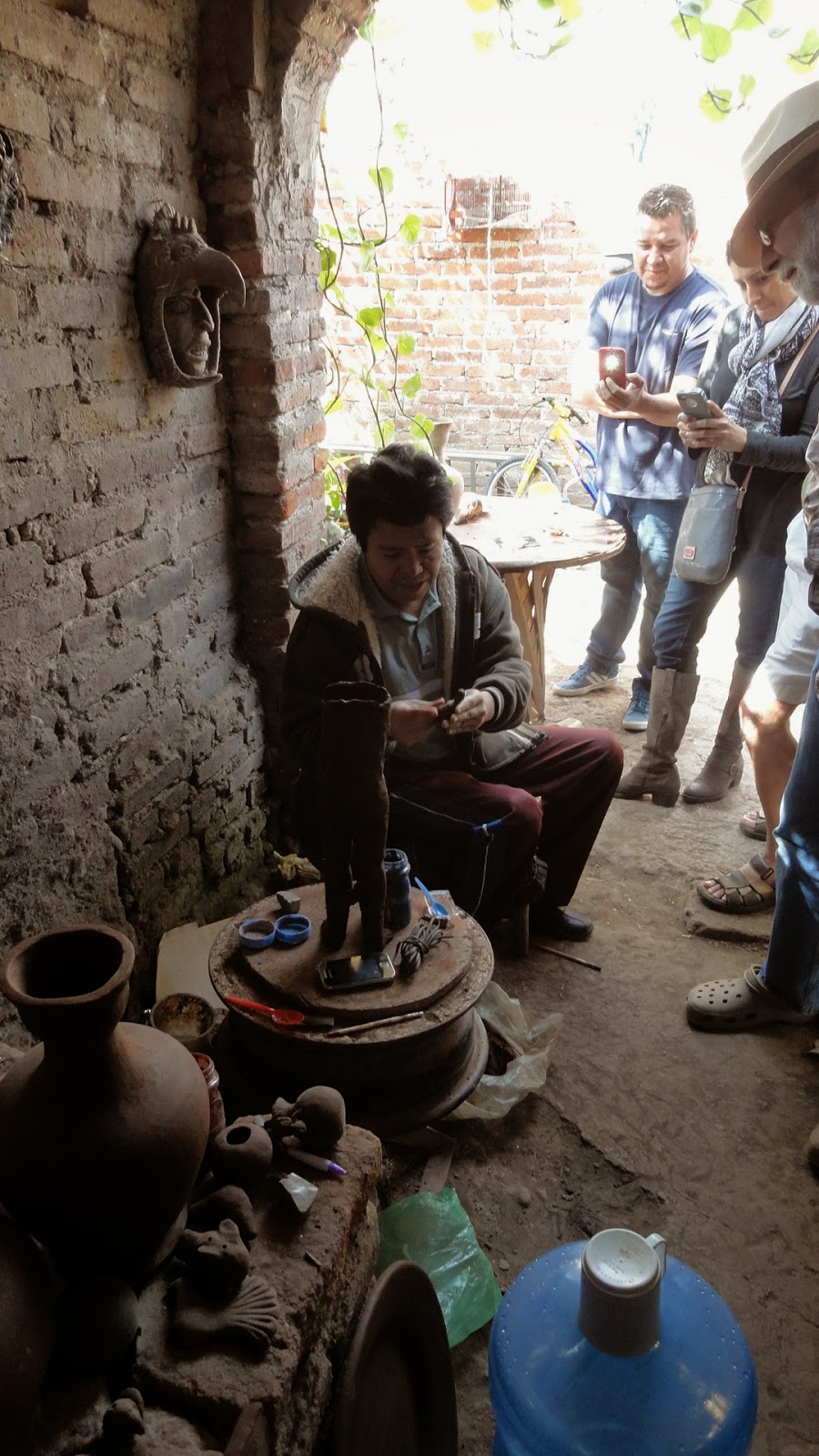
It was really fun to find work in the gallery by an artist we visited this year. When we were at Roca Azul in January we took an interesting day trip we called the Cajititlan Loop. One of the stops we made was at the home and workshop of a well-known potter named Martin Ibarra Morales. He had some of the most exquisite virgin statues that I have ever seen and I ended up buying one. There's more about him and more pictures at Cajititlan Loop Day Trip 


I was lucky enough to be able to purchase my virgin statue directly from Martin. Three of his virgins are displayed on the table below.  The prices on them were much higher than I paid for mine. Nothing like buying directly from the artist. Martin's picture is with the virgins.


The Tianguis


San Miguel has what is known as a 'Tianguis, or open air traveling market, on Sundays and Tuesdays. Vendors come in and set up their stalls in the morning, work all day, take them down that evening, and move on to the next town the following day to do it all over again. It looks like soooo much work.
One estimate of the size of the Tuesday Tianguis is about three football fields and I would concur. The Sunday Tianguis is about half that size. The San Miguel Tianguis is in a permanent spot that has poured concrete pads, poles to tie the tarps or ceiling covers to, electricity, and water. It's like a little town that springs up twice a week.
We love to wander around and look at all the stalls offering an amazing variety of merchandise. As we stroll along we get some of the most enticing smells from the food stands and of course have to try things out. Great food and great prices. This place was a favorite - note the rotating barbecue skewer. Seasoned meat is shaved off, quickly grilled and served in a couple of different ways.


Thursday, February 27, 2014

Mineral de Pozos


We took a day trip to Mineral de Pozos, about 35 miles away from San Miguel de Allende. It has been called a ghost town for many years and was abandoned twice after being founded. Recently (can't find a date) the Federal Government of Mexico gave it the designation ' Pueblo Magico' and is putting money into its redevelopment. The town and the surrounding area have old gold and silver mines, and many ruins.


We were joined by a few dogs in our walk around town. Tilly pretty well ignored them but they really liked Brian.


This picture of a church shows the various types of walls, from new to old.
More walls. The black that looks like mortar is actually little black stones. 
We saw construction and reconstruction all over town. The central plaza is being torn up and redone. Note the animals built into the bench with rock.


There will be restaurants, shops, and galleries all around the square. Some were open but most were closed. It could have been because of the construction, or maybe it was the day or time of day when we were walking around.


We saw several upscale modern houses, some beautiful B&Bs and a few boutique hotels. This place is definitely being discovered and is gaining a reputation as an artists' community.


We saw signs that had numbers and actually said in English 'Art Walk.' I guess that says something about the changes going on. We stopped at one of the places which was a women's cooperative. The women hand-make costumes for dolls, and each one represents either a state, area, or figure in Mexico. They were very nicely done and we decided to show our support by purchasing one.


Walking around town was really interesting and we had fun taking pictures. Too many to post but here are a few.


Cool doorway

Another cool doorway
Our route from SMA (San Miguel de Allende)


The Butterfly Sanctuary


 "Have you been to see the butterflies?" When talking with fellow RVers in Mexico it seems this question always comes up. We can finally reply "YES." We have wanted to go to the Santuario Mariposa Monarca, Monarch Butterfly Reserve, for years but couldn't figure out the best way to do it. We finally figured it out and are now able to knock it off our bucket list. It was a magical experience to say the least.

The Reserve is located in the easternmost part of the state of Michoacan, northwest of Mexico City. It is in a stretch of mountainous forests that provide what is needed for the wintering monarchs.


We were fortunate to join some fellow RVers  in San Miguel de Allende on a guided day trip to the Reserve. It was a long trip, about 3 1/2 hours each way, in a crowded van but fun nonetheless. Our route took us to the viewing location near Angangueo – about 145 miles from San Miguel. The highest point we reached according to our Garmin was about 11,200 feet above sea level. There is another viewing area outside the town of Ocampo where many tour buses visit.


The sanctuary is 160 square kilometers and has been decreed a Reserva Especial de la Biosfera and World Heritage Site so it is a protected area. Protection of the area didn't begin until the 1980s and in 2000 it attained the status of Federal Biosphere Reserve. Within the Reserve there are at least 8 areas the monarchs are known to congregate. The public is only allowed to visit 2 of these areas.

It's estimated that anywhere from 60 million to 1 billion monarch butterflies come to the Reserve every autumn to mate. Today's number may be less than in the past due to a number of factors. The monarchs fly over 2,400 miles from the the Eastern US and Great Lakes region of the US and Canada to the Reserve.


The monarchs' survival depends on the large number of habitats encountered to and from their annual migration from Canada, the United States and Mexico. These three countries adopted a plan in 2008 for the conservation of the butterfly’s habitat through its migration routes. In February 2014 when the President of Mexico met with the President of the US and the Prime Minister of Canada in Toluca, outside Mexico City, the plight of the monarchs was one of the topics to be discussed. Within the Reserve in Mexico, the greatest threats to the butterfly habitat are deforestation, illegal logging, unorganized tourism, forest fires and lack of cooperation among various authorities.

The monarchs arrive in late October or early November and leave in March, spending about 5 months in the Reserve. No one is allowed to visit the Reserve until late November so that the monarchs have time to form their colonies and begin their hibernation. They are very sensitive to any changes in their environment. We were told that when construction of some buildings in the parking area created too much noise the butterflies went down into the canyons to escape the noise, and very few people were able to see them that year.

When we arrived at the Reserve we decided to ride horses to the top of the mountain since we didn't feel quite ready for hiking at over 10,000 feet. I am not a horse person, so I was quite happy to get a horse that just followed the one in front of it. Thankfully all I had to do was hang on to the saddlehorn.


When we got up to the viewing area we were told to be silent. It was easy to do when surrounded by such majesty. It was still cool and there were clumps of thousands of butterflies in the trees, gathered together with wings folded, weighing down the branches.


Typically when it gets warmer, usually sometime in mid-February, the monarchs come our of hibernation and begin to mate. We timed our visit just about right.


As the day warmed up they began to flutter around in the sun. It's an amazing sight and one that I can't do justice to with my camera. The sun caught their wings and flashes of gold and orange were everywhere.


Our guide told us that it takes 3 males for every female when mating. It was difficult to find any information on this, but one website was helpful  http://www.learner.org/jnorth/tm/monarch/MatingDescription.html   It says that when the males mate they pass a package called a spermatophore which contains not just sperm but other nutrients needed by the female. This could explain the need to mate with more than one male. We saw the monarchs mating on the ground and when they finished they flew up into the sky with the males carrying the females underneath. Our guide called it 'the nuptial flight.' They stay coupled for many hours, often overnight, until the exhausted male dies.

The pregnant females fly northward to the mid and southeastern parts of the United States where they lay their eggs on milkweed bushes, then die themselves. They will only lay their eggs on milkweed and that has become one of the problems with their survival. Necessary milkweed bushes have been cut down and are disappearing in many areas.

The eggs hatch into caterpillars that feed on the milkweed, then make cocoons and emerge in late May as a new generation of monarchs. These first generation monarchs will mate, lay eggs, and die. Their eggs will start the cycle over again, each generation lasting about 8 weeks, as they make their way north the forests in the Great Lakes region. By mid-August a generation that is somewhat physiologically different emerges. This one is in kind of a suspended development so it is capable of making the long trip south to the Reserve. They drink nectar and catch warm air currents that allow them to soar instead of using powered flight as they go.

We recommend an excellent book by Barbara Kingsolver called Flight Behavior . It's a  New York Times Bestseller, and was declared "Best book of the year" by the Washington Post and USA Today.  The story is about what happens when the monarch butterfly's habitat in Mexico is destroyed and the butterflies migrate to the Appalachians. Interesting plot and characters but also a strong commentary on the effects of climate change.  http://www.kingsolver.com/books/flight-behavior.html

There is a wealth of information on the monarch butterfly. More links ...
http://mariposamonarca.semarnat.gob.mx

http://www.visitmexico.com/en/michoacan-where-monarch-butterflies-migrate

http://www.monarch-butterfly.com/monarch-migration.html

http://animals.nationalgeographic.com/animals/bugs/monarch-butterfly

And the bad news
http://www.kingsolver.com/books/flight-behavior.html

http://www.washingtonpost.com/lifestyle/kidspost/monarch-butterflies-skipping-trip-to-mexico/2014/01/31/478131c8-8929-11e3-916e-e01534b1e132_story.html

http://www.nytimes.com/2014/02/14/world/americas/north-american-leaders-urged-to-restore-monarch-butterflys-habitat.html?_r=0

http://www.theglobeandmail.com/globe-debate/what-the-3-amigos-should-talk-about-today-monarch-butterflies/article16965981/#dashboard/follows

Friday, February 21, 2014

Fabricas de Ladrillos, Brick Factories

http://es.wikipedia.org/wiki/Ladrillo

Travelers in Mexico may often see smoke. In some cases that smoke could come from a small, family operated brick factory. Many buildings in Mexico are constructed of these bricks. They have been doing it this way for hundreds of years. Bricks have been used in construction as far back as 10,000 years ago. We have read there could be as many as 20,000 of these small brick factories in Mexico.


Mud is used to make the bricks. Mud is put into forms to shape it. I am not sure if this mud is some special combination of ingredients. The mud stays in the forms for a while until it is partially dry. It is then removed from the forms and the mud continues to dry. 

    
As the mud dries they reposition the bricks so that all sides can dry. They then begin to stack the bricks to form a kiln. 

       
The stacking of the bricks seems to be quite a technical process. There must be space between the bricks so the heat from the fire can circulate and heat all of the bricks evenly. 


As the bricks are stacked the workers build older, used bricks around the outside of the stack – this will be sealed to form the kiln.


Mud is used to seal the exterior of the kiln. More old bricks are stacked on top to form a sort of roof and to seal the top of the kiln. I am not totally sure but it seems they put wood and other materials in between the bricks as they build the kiln. This would then burn evenly throughout the kiln. The kiln fire is tended for about a day.

But there is a problem – or two. The smoke from these kilns can be toxic. Though many of these kilns use special wood and even dried coconut shells there are some that use garbage and even used tire rubber – bad stuff. At least a couple of organizations are working with the brick makers in Mexico to reduce pollution. I read of at least one new kiln design that is suppose to greatly reduce emissions. Hopefully help is on the way.


After the fire has burned long enough and the bricks have started to cool they start to disassemble the whole kiln and load the completed bricks on trucks. Below is a truckload of dried coconut shells we think they use as fuel for fires at this factory. In the background a new kiln is being built from the latest batch of bricks. 


In many towns all over Mexico there are brick trucks on the side of the road waiting for customers to buy the bricks. Some buyers only need a certain number of bricks and can pick them up in their pick-up trucks. Other buyers may want the entire truckload of bricks. Each of these trucks is probably from a different factory. 


Here is a US brick next to a slightly used Mexican brick. The Mexican brick is larger. 


Below are some brick sizes for different countries that I found online.

Face brick ("house brick") sizes, (alphabetical order)
Standard Imperial Metric
 Australia 9 × 4⅓ × 3 in 230 × 110 × 76 mm
 Denmark 9 × 4¼ × 2¼ in 228 × 108 × 54 mm
 Germany 9 × 4¼ × 2¾ in 240 × 115 × 71 mm
 India 9 × 4¼ × 2¾ in 228 × 107 × 69 mm
 Romania 9 × 4¼ × 2½ in 240 × 115 × 63 mm
 Russia 10 × 4¾ × 2½ in 250 × 120 × 65 mm
 South Africa 8¾ × 4 × 3 in 222 × 106 × 73 mm
 Sweden 10 × 4¾ × 2½ in 250 × 120 × 62 mm
 United Kingdom 8½ × 4 × 2½ in 215 × 102.5 × 65 mm
 United States 7⅝ × 3⅝ × 2¼ in 194 × 92 × 57 mm  

MEXICO  -  bricks can vary in size but the standard seems to be about the same around Mexico. Larger bricks can be made for different uses. 

STANDARD 
25 centimeter = 9.84 inch 
12 centimeter = 4.72 inch 
5.25 centimeter = 2.07inch

UP TO 
50 centimeter = 19.68 inch  
24 centimeter = 9.45inch
5.25 centimeter = 2.07inch

To be clear – houses in Mexico may also be made of concrete block and other such materials, and these materials can be found. But as we look around we find most construction of homes is done using these bricks. 

Entire neighborhoods all over Mexico are made from these bricks. Some houses are finished by using mortar to stucco the outside of the houses and then painting them, but many houses are left with the bricks exposed and unfinished. The inside of these houses are probably finished. Some houses have the front finished but they leave the sides as raw brick. Some houses are constructed with the intent of leaving the bricks finished so the masonry work is more cleanly done. Other houses appear to be waiting for the outside to be finished. We have been told – no idea if this is true – that many Mexicans do not finish their houses as they pay either very little or no tax until the house is completed. 


Here is another website with more about making bricks in Mexico. 

Wednesday, February 19, 2014

Patzcuaro Museo de las Artes Populares

This was our first visit to the Museo which displays both colonial and contemporary crafts. It was interesting and informative and we were glad we finally explored it.
The first room we came to had a rather interesting floor.


That's not grout or stones between the larger stones, but cow knuckle bones (best translation we could figure out).


There was a traditional loom which was pretty much the same as the looms we saw at La Casa de los Onces Patios that are being used today.


The fishermen of Lake Patzcuaro are known for their wooden canoes and butterfly nets which are still being used.


We saw this truck with the same type of canoe while in town one day.


There was an extensive pottery display with representatives of the many styles in this area.


The pottery with the green glaze is seen in Tzintzutzan, a town on the northeast shore of the lake.


There were a great many textiles similar to what we have seen in town. This traditional dancer was wearing some of them.


This mask was in the wooden crafts area -  a bit scary for me.


In back of the museum is an area that has a troje, which is is a traditional Purepecha (native) house.


Brian has always been fascinated with how things are constructed and thought the width of this wall near the troje was pretty amazing.


I really enjoyed learning about 'Pasta Cana' the subject of this display. The statue looks as if it's made from wood, but it's not.


The base for a Pasta Cana sculpture is corn stalks. A paste is made from the corn stalks, a piece of wood is inserted in the center for strength, and the layers of corn stalks are built up. It's then dried and painted to make processional sculptures that are lighter and far easier to carry. This technique was developed by the indigenous people before the arrival of the Spanish.
We watched a video about this, and this display explained some of the process.


Very interesting museum and well worth the time to visit.