Monday, April 22, 2013

Spring Has Sprung

This is a beautiful time of year to be in Arizona. The desert is full of life, and the flowering cactus and succulents have been incredibly large this year. Our friend Laura came for a visit from Colorado and one morning we took a hike up to a ridge overlooking Fountain Hills. Great view of the fountain and surrounding area.


Since the last time I hiked the ridge they have put in several nice benches along the way.


Every morning we walk Tilly around the fountain. Lots of flowering cactus with huge flowers. I took 2 shots of this one to put size into perspective a bit.


The blooms on the cactus only last about 24 hours. I took this shot one morning
 
 
and this shot the next morning of the same cactus.
 
 
One of my favorite cactus is called an ocotillo. They grow quite tall and branch out
 
 
and have exquisite flowers among the thorns.
 
 
I don't know the name of these succulents but assume they are some type of agave. The stalks coming out of them are HUGE.


I took this picture down the street from us because I was amazed at how tall they were growing in pots.


The palo verde trees are in full bloom as well. They're very messy trees and not particularly great for allergies but they're beautiful when they bloom.

 
We don't know why everything is blooming so well this year and haven't had an explanation from some of the locals we talk to either. Enjoyable to see though.
It's starting to heat up a little which usually signals the end to our time in this area. Lots of projects have been done and we'll be ready to hit the road within the next few weeks if all goes well.

Monday, March 18, 2013

Guanajuato and on to Arizona


After leaving SMA we headed for Guanajuato. We were there a year ago and knew that it would take more than one visit to see more of the city. Some of the history and information that we found interesting on our previous visit can be found by linking to last year's post. I wrote about some of the history of this area and the role of the hero Pipila whose massive statue overlooks the city as seen in the photo above.
Guanajuato is built around a narrow valley. Colorful houses are perched on steep hillsides and streets wind up and around the city.
The streets of Guanajuato follow the rugged mountainsides with small alleyways, plazas and in some cases steep staircases up hillsides. Our friends Ericka, Antonio, and Andoni joined us for the weekend and showed us some of their favorite places. Here they are posed with Brian at the bottom of one of these staircases next to an Irish Pub(?).
Because of its topography there isn't one main plaza as there are in many Mexican towns. Instead, the alleyways and staircases link a series of plazas, mansions, and historic buildings. This gives Guanajuato a bit of a European flavor.
 
The streets in the central historic district are narrow and winding but very picturesque with decorative balconies and colorful flowers. This is a town that is better seen on foot than in a car, although we did see some smaller buses navigating the streets.
 
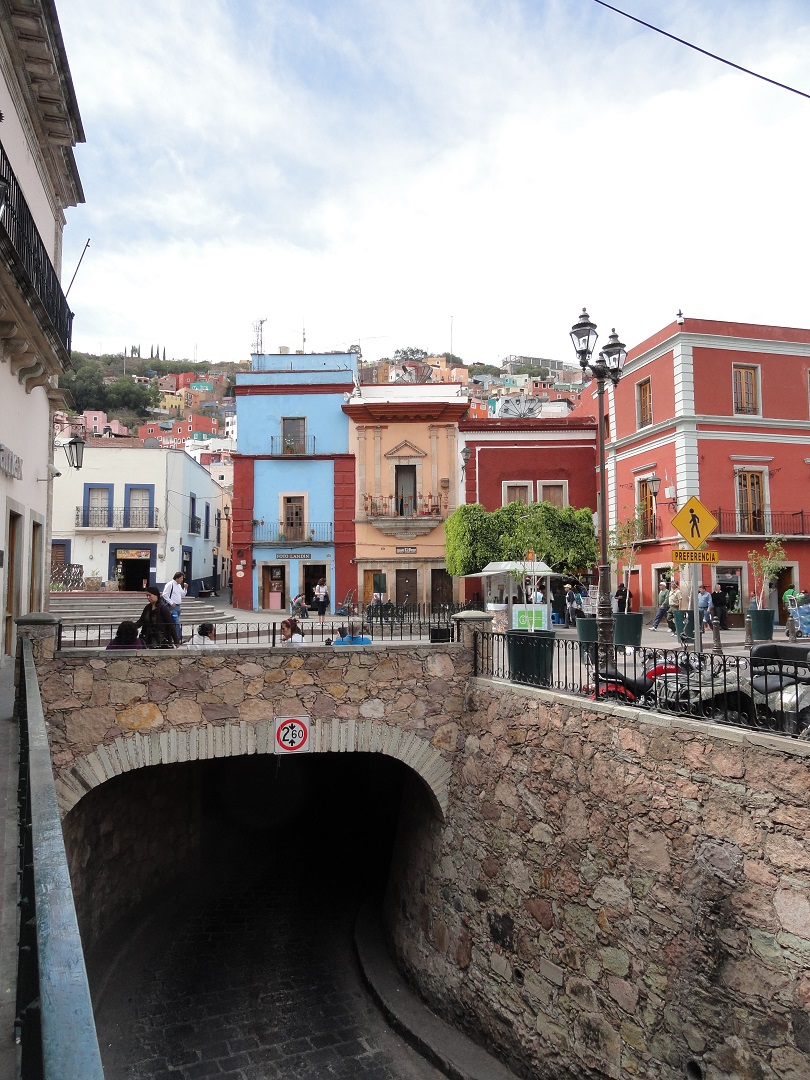
The tunnels in Guanajuato are a distinguishing feature that make driving a nightmare. The city was prone to flooding so a series of long channels were dug to divert the water. Today these tunnels have been converted into roadways. They are extensive and complex. Maps of the city show roads and routes but it's very confusing because the roads are on two levels and it's not easy to figure out which are underground. In addition, the tunnels are adequate for cars and small buses, but definitely not most RVs. It's always a horror story when we hear of a fellow RVer who somehow ended up in the tunnels.
The following map of Guanajuato shows streets which have solid lines for the border, tunnels which have dotted lines for the border, and the alleyways are dotted lines. Difficult to see, but clicking on the map will enlarge it and give an idea of what I'm trying to convey. Crazy and what a maze to navigate.
 
Entrances to the tunnels are found throughout the city.
Although it's no fun for driving, we really love walking around and seeing the sights. One of the places we went last year was the Teatro Juarez but we were unable to get inside at that time. This year we toured the magnificent interior.


I took a picture of this alleyway leading to a beautiful brick building with pink flowerboxes because I thought it was a pretty cool scene.
A few minutes later while I was doing a little silver jewelry shopping -this is the silver city- Brian told me to come out and see what was coming down the walkway. Love it.
A few other street scenes....


Andoni, Ericka, Sue and Brian in one of the plazas.
 

We had a great time in Guanajuato, and as I said in my last post there's so much to see and do that we'll have to return again and again. After leaving Guanajuato we headed back to Arizona, where we'll be for a few months taking care of business until it gets too hot and we're ready to hit the road again.
Maps of our journey follow
 
San Miguel de Allende to Guanajuato, approximately 50 miles
Guanajuato to the Columbia Crossing in Texas


Friday, February 22, 2013

San Miguel de Allende, Pueblo Magico


After spending time here for over a month (a long stop for us) it was time to move on. It's been great making new friends and re-connecting with old friends. At long last we were able to meet Terri and Mike Church face-to-face. They are the authors of the book Traveler's Guide to Mexican Camping which is known as the Bible and an invaluable guide to the majority of RVers in Mexico. We had an enjoyable lunch at one of our favorite restaurants, and they also joined us for some great music at a club where our friend Rick plays. Wonderful to meet them, as well as so many others we met in SMA.


As usual we enjoyed walking around town, peering into doorways and admiring the architecture.


We were lucky to be in town again this year for the big plant and flower show at the Parque Juarez.


We viewed the mural at the Cultural Center Belles Artes or Central Cultural Ignacio Ramirez "El Nigromante" that was started by David Alfaro Siqueiros in the 1940s but never finished. He was a leading Mexican Muralist, along with Diego Rivera and Jose Clemente Orozco. Siquieros had a colorful history which included leading an attack on Trotsky's house in Mexico City. More information about him can be found here.
We took our friends Bill and Sandy from British Columbia and Richard and Brenda from the Yukon to view the unfinished mural. Very cool and intriguing to try to figure out what the finished product would look like.


The Parroquia is one of the most, if not the most, photographed and painted churches in Mexico.


A few years ago we were able to watch as it was cleaned from top to bottom. This year we happened to glance up and see the lights at the top being changed. It looked a little scary, but the waiter at our rooftop restaurant assured us that it was being done by professionals.

 
Many of the buildings in SMA are very old and undoubtedly require a great deal of maintenance. Interesting to watch these guys cleaning and dusting one of the giant doors.
 
 
This fine looking  RV belonging to Susie and Gary from New Mexico came into San Ramon. Seeing double?
 
 
 We always enjoy our time in SMA and know why it's a World Heritage Site, Pueblo Magico and National Monument.  Of course we shall return.

Thursday, January 31, 2013

Atotonilco

 
Galeria Atotonilco is a very impressive art gallery located just north of SMA. Ordinarily the gallery is open by appointment only, but last Sunday there was a special exhibit open to the public. The gallery is spread out over 2 large buildings, including the one seen above which is also the home of the gallery owners.
 
 
The gallery has an incredible variety of arts and crafts from all over Mexico. It seems that just about every state was represented with works from local artisans. Our friends Antonio and Ericka accompanied us and they, too, were amazed. Ericka commented that she wanted to thank the owner for his demonstration of respect and love for her country. I agree.
 
 
One of my favorite art forms, Trees of Life, were featured at this exhibit. Several can be seen above. Traditionally the Tree of Life is a tree sculpture featuring Adam and Eve with the tempting serpent, but the artform has expanded to themes including Day of the Dead and other local folk art themes. The Trees come from several different areas of Mexico. Some of them are very intricate and of course are priced accordingly. The ones in the photo above are colorful but not terribly intricate. The one below is a modern depiction.
 
 
The entrance to the house part of the gallery with more museum quality art
 
 
and a large sculpture of a praying mantis. One of my favorite pieces of Mexican art is a praying mantis from Oaxaca that I bought a few years ago. It's not quite as big as the praying mantis at the entrance but very similar in design.
 
 
Following our visit to the gallery we made our way to the Sanctuary of Atotonilco, which is a World Heritage Site.  The main feature of the church complex is the Mexican Baroque mural work on the walls and ceilings of the church. Because of the vivid mural work the church is often called the Sistine Chapel of Mexico. People still worship at the church, and it attracts as many as 5,000 visitors per week. Once again it's very difficult to impart the scope of what we saw through pictures, but hopefully the photos that follow can give a rough idea.
 
Looking toward the altar, murals cover just about everything

 
Close-up of the ceiling
 
Very elaborate altar of the Virgin of Sorrows
Brian, Antonio and his son Andoni walk past the church entrance
 
It's always amazing to see the inside of the Mexican churches. Many are plain or fortress-like on the outside and exquisite on the inside. We have commented several times that no two are the same. They all are unique in their own way.
 
Links for more information