Saturday, March 15, 2014

Queretaro

Statue of an Otomi soldier
Our friends Antonio and Ericka live and work in the lovely city of Queretaro which is about 45 miles from San Miguel de Allende. Our mutual friends Rick and Ruth had been to the commercial area of the city but not the historic zone. Last time we all got together we decided we would take a day trip to meet Antonio and Ericka for some touring and lunch. Queretaro is an impressive city with a very European feel, full of quaint plazas, colonial buildings, some of which date back to the 17th and 18th centuries, and interesting pedestrian walkways.


The Historic Monuments Zone of Queretaro was named a UNESCO World Heritage site in 1996 and there are statues and fountains everywhere.  I love the fountain above with the water coming out of the dogs' mouths. The statue below is of Josefa Ortiz de Domínguez (known as La Corregidora). She was a supporter of the Mexican Independence Movement. In 1810 she warned the rebel leaders of an upcoming attack to take place in San Miguel de Allende. The rebel leaders were able to escape and three days later the Mexican War of Independence began. This is only one of the tributes we saw to her throughout the city.


One prominent feature of Queretaro is its enormous aqueduct, consisting of seventy five arches, each twenty meters wide with a total extension of 1,280 meters and an average height of twenty three meters. It was built between 1726 and 1738 at the request of the nuns of the Santa Clara Convent to bring water to the residents of the city. While the aqueduct no longer carries water, it has been well preserved and maintained.


We enjoyed seeing the sights and getting caught up on things over lunch.


Querétaro has repeatedly been recognized as the metro area with the best quality of life and as the safest city in Mexico. It was completely charming and we will be back.
Once again, we took a lot of photos and will share some of our favorites below.


Queretaro is known for its abundance of purple flowering jacaranda trees, as seen in this photo.

This dog on the roof  was keeping a lookout, maybe watching for the 3 amigos in the photo below.


A small section of a door that was at least 10 feet tall.


Our route...


Friday, March 14, 2014

Lord of the Conquest, San Miguel de Allende


The festival of El Senor de la Conquista,  Lord of the Conquest, is an annual tradition held the first Friday in March in San Miguel. It celebrates an event that took place in 1575 when two Spanish priests who were transporting a figure of Christ were attacked and killed south of San Miguel. The figure was later fetched by the villagers and has since been worshipped, especially in this area. There is a similar figure in another town in Mexico but there is no special celebration there - San Miguel has become the capitol of this festival.


Dancers from several parts of the country converge in San Miguel and dance in the streets around the Jardin and in front of the Parroquia.


We could feel the loud beating drums going right through us as we approached the Jardin. The colorful dancers were dressed in a pre-Hispanic manner with seed pods rattling around their ankles and huge plumed headdresses.


These dancers were particularly interesting in their traditional garb with CDs placed here and there.


The figure of the Lord of the Conquest is usually in a side altar at the Parroquia but is moved to the main altar during the festival as a symbol of the power of God and his love for the Indians. Groups performed in front of the Parroquia doors leading to the main altar, dancing to the rhythmic drums and conchas.


The concha is a traditional stringed instrument similar to a guitar and is made out of an armadillo shell. 


It was fun to be present for this festival which was a photographer's delight, judging by the number of people taking pictures. A few more of our favorites...


Links with more information


Sunday, March 9, 2014

Bernal

Church in the central plaza or jardin
The small town of Bernal is a Pueblo Magico located about 80 miles from San Miguel de Allende. A plaque on the building pictured below states that 'It is a mystical and enigmatic destination, with a historic and cultural legacy, therefore it was named a Pueblo Magico in 2006 by Mexico's Ministry of Tourism.'


Bernal is at the base of a rock called Pena de Bernal. The rock is believed to impart a kind of cosmic mystical energy, and Bernal's residents are said to be the longest lived in Mexico with many of them living well into their nineties. They maintain that the forces within the rock are responsible for their longevity. Other places throughout the world have been identified as places with similar cosmic or mystical energies. Haystack Mountain outside of Boulder, Colorado and Sedona, Arizona are two of the places we have been to that are considered to be sacred sites because of these energies.


Pena de Bernal can be seen towering over the town and made a good reference point while we were wandering and driving around.


In 2013 Pena Bernal was officially named the world's tallest rock. I read that it took a great deal of argument for it to finally acquire this status.  For many years scientists had said that the Rock of Gibraltar and Sugarloaf in Rio de Janeiro, were both taller than Pena Bernal.  However, the scientific journal 'Geosphere' finally settled the competition and declared that Peña de Bernal is the world’s tallest free standing rock. Surprisingly, it took this long for the rock to be accurately measured in terms of its height. A team from the National Autonomous University of Mexico settled the rock's vital statistics. It is 1,421 feet high (that’s 433 meters) which is higher than Gibraltar at 1,398 feet (426m) and the Sugarloaf which trails in third at 1,299 feet (396m). According to Leonor López Domínguez of México Desconocido, Pena de Bernal was formed some 100 million years ago during the Jurassic period, when it must have been at least three times higher than today


Bernal is an enchanting town. The buildings are colorful with lots of little details, each one different from the next.


The face of the building centered in the arch is completely tiled.


 This church, which has a similar color scheme to the one in the main plaza, is now a museum.


 On the weekends Bernal has a thriving tourist business, but it was pretty deserted during the week which was nice for us.


We found a great little spot for a picnic below the rock.


We kept hearing voices off in the distance and figured out that there was a group of people climbing the rock. This side of the rock is quite difficult to climb as opposed to the other side which has a hiking trail. Many people make a pilgrimage to the highest point of the hiking trail, visiting a little chapel about halfway up.
On this side it seemed like it should be done either with a guide or by those who had some experience.
The first photo shows the top of the rock with climbers ascending, and the second is a closer look - there are twelve climbers.


 We found a website that gives information about doing the climb with a guide at   http://www.exxichallenge.com/#!product/prd1/1287849061/ascenso-cumbre-de-bernal

Our route from San Miguel to Bernal which took about 1 1/2 hours.


Sunday, March 2, 2014

Back in San Miguel de Allende with the Giant Heads

 Mojigangas


Although we seem to spend quite a bit of time in San Miguel de Allende on our winter journeys we have never before seen this sight coming down the street. We started calling them Giant Heads but did a bit of research and found that the proper name is Mojigangas and they have a pretty interesting story.  The mojigangas do more than just walk down the street to have their pictures taken with the tourists. They are an essential part of fiestas that take place in San Miguel. One month before the eve of Independence Day they gather at the cemetery to ask the spirits to bless their upcoming efforts. The following day they dance in the jardin to let people know the fiestas are almost here.


Historically, figures similar to these were brought to Mexico by the Spaniards around 1600. During this time the Mojigangas were used in religious pilgrimages but were also fashioned as effigies to ridicule public figures. Seems that could be true now as well.

More pictures and information about the mojigangas can be found at  http://www.zocalotx.com/MOJIGANGAS.htm

Galeria Atotonilco


We had an opportunity to attend an open house at Galeria Atotonilco. We went there last year, and I blogged about it here   Atotonilco blog   It was just as amazing this year, with an incredible amount of arts and crafts from all over Mexico.

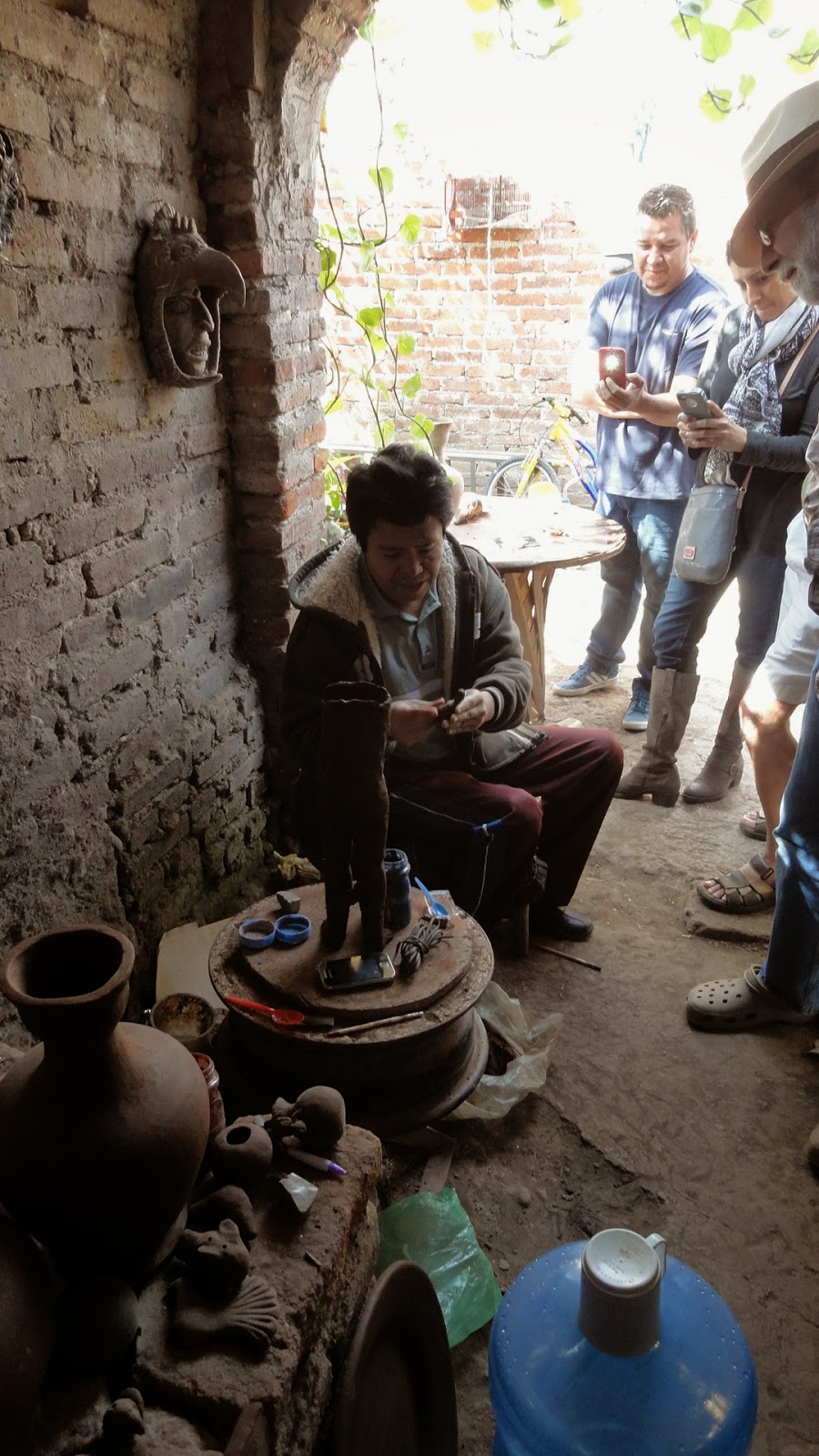
It was really fun to find work in the gallery by an artist we visited this year. When we were at Roca Azul in January we took an interesting day trip we called the Cajititlan Loop. One of the stops we made was at the home and workshop of a well-known potter named Martin Ibarra Morales. He had some of the most exquisite virgin statues that I have ever seen and I ended up buying one. There's more about him and more pictures at Cajititlan Loop Day Trip 


I was lucky enough to be able to purchase my virgin statue directly from Martin. Three of his virgins are displayed on the table below.  The prices on them were much higher than I paid for mine. Nothing like buying directly from the artist. Martin's picture is with the virgins.


The Tianguis


San Miguel has what is known as a 'Tianguis, or open air traveling market, on Sundays and Tuesdays. Vendors come in and set up their stalls in the morning, work all day, take them down that evening, and move on to the next town the following day to do it all over again. It looks like soooo much work.
One estimate of the size of the Tuesday Tianguis is about three football fields and I would concur. The Sunday Tianguis is about half that size. The San Miguel Tianguis is in a permanent spot that has poured concrete pads, poles to tie the tarps or ceiling covers to, electricity, and water. It's like a little town that springs up twice a week.
We love to wander around and look at all the stalls offering an amazing variety of merchandise. As we stroll along we get some of the most enticing smells from the food stands and of course have to try things out. Great food and great prices. This place was a favorite - note the rotating barbecue skewer. Seasoned meat is shaved off, quickly grilled and served in a couple of different ways.